Medicine has a delivery problem.
Some of the most interesting compounds in modern medicine — peptides, hormones, metabolic molecules and other biologically active compounds — work extremely well once they reach the right place in the body.
Getting them there is the problem.
That is why so many of them come with a needle.
Why can't you just swallow a peptide?
The gastrointestinal tract is remarkably effective at doing the exact opposite of what a peptide drug requires. Its job is to break complex biological material down.
Proteins and peptides are exposed to changing pH, digestive enzymes and an intestinal barrier designed to tightly regulate what enters the bloodstream. Even after a molecule crosses the intestinal wall, compounds absorbed through conventional gastrointestinal pathways may travel through the portal circulation to the liver before reaching systemic circulation.
That process is known as first-pass metabolism.
For many molecules, the consequence is straightforward: only a fraction of the original oral dose ultimately becomes systemically available.
Prism's scientific platform begins with a different question: what if the molecule never had to take that route?
There is another door into the bloodstream
Lift your tongue.
The tissue underneath it — the sublingual mucosa — is thin, highly vascularized and considerably more permeable than many other surfaces in the oral cavity.
A molecule that successfully crosses this tissue can enter venous circulation without first passing through the stomach and intestinal tract and without undergoing the same initial hepatic first-pass route associated with conventional swallowed administration.
That distinction is basic pharmacokinetics, not marketing.
Prism's independent NAD+ formulation report describes the sublingual mucosa as a comparatively thin and permeable oral surface and identifies sublingual delivery as particularly interesting for compounds challenged by gastrointestinal delivery, low permeability or rapid metabolism.
But there is an important catch: putting a molecule under the tongue does not automatically mean it gets absorbed.
That is where most explanations of "sublingual delivery" become far too simplistic.
Dissolving is not the same thing as absorbing
A tablet can disappear in your mouth and still deliver most of its payload to your stomach. A liquid can sit under the tongue and still be swallowed. A strip can dissolve beautifully and still have poor systemic bioavailability.
The relevant endpoint is not how quickly the dosage form disappears. It is how much active molecule actually crosses the mucosal barrier intact.
And that depends heavily on the molecule itself. Molecular weight matters. Electrical charge matters. Lipophilicity matters. Chemical and enzymatic stability matter. The concentration gradient matters. Residence time against the tissue matters. And the formulation surrounding the molecule can matter enormously.
This is why Prism does not treat "sublingual" as a single technology. It is a route of administration. The formulation is the technology.
NAD+ shows the problem perfectly
NAD+ is a useful example because it is almost the opposite of an easy mucosal-delivery molecule.
It is relatively large. It carries substantial charge. And despite being water soluble, it has poor passive permeability across biological membranes.
Prism's independent formulation work therefore classified permeability — rather than simply solubility or dose — as a central constraint for transmucosal NAD+ delivery. The report evaluated enabling strategies including permeability enhancement, cyclodextrin complexation and lipid-based carriers precisely because simply placing more NAD+ under the tongue does not solve the underlying transport problem.
This is one of the most important principles in drug delivery: when absorption is the bottleneck, increasing the dose is often a very inefficient solution.
You have to solve the barrier. The same principle becomes even more relevant with larger peptide molecules.
ODT: a better first step
An orally dissolving tablet, or ODT, can provide an elegant first-generation delivery format.
Rather than asking a patient to inject a refrigerated vial, the dosage form rapidly disintegrates in the mouth. Depending on the formulation and molecule, this creates an opportunity for sublingual or buccal exposure before material is swallowed.
That is a meaningful improvement in user experience. No syringe. No reconstitution. No injection technique. And potentially far less cold-chain dependence.
But ODTs still have limitations. Once the tablet dissolves, saliva moves the formulation throughout the mouth. Some material will inevitably be swallowed. Contact with the optimal absorption surface can vary between patients. And the drug is not necessarily being directed toward the tissue through which we want it to travel.
That is why Prism views the oral thin film as the more important architecture.
OTF: turning a dosage form into a delivery system
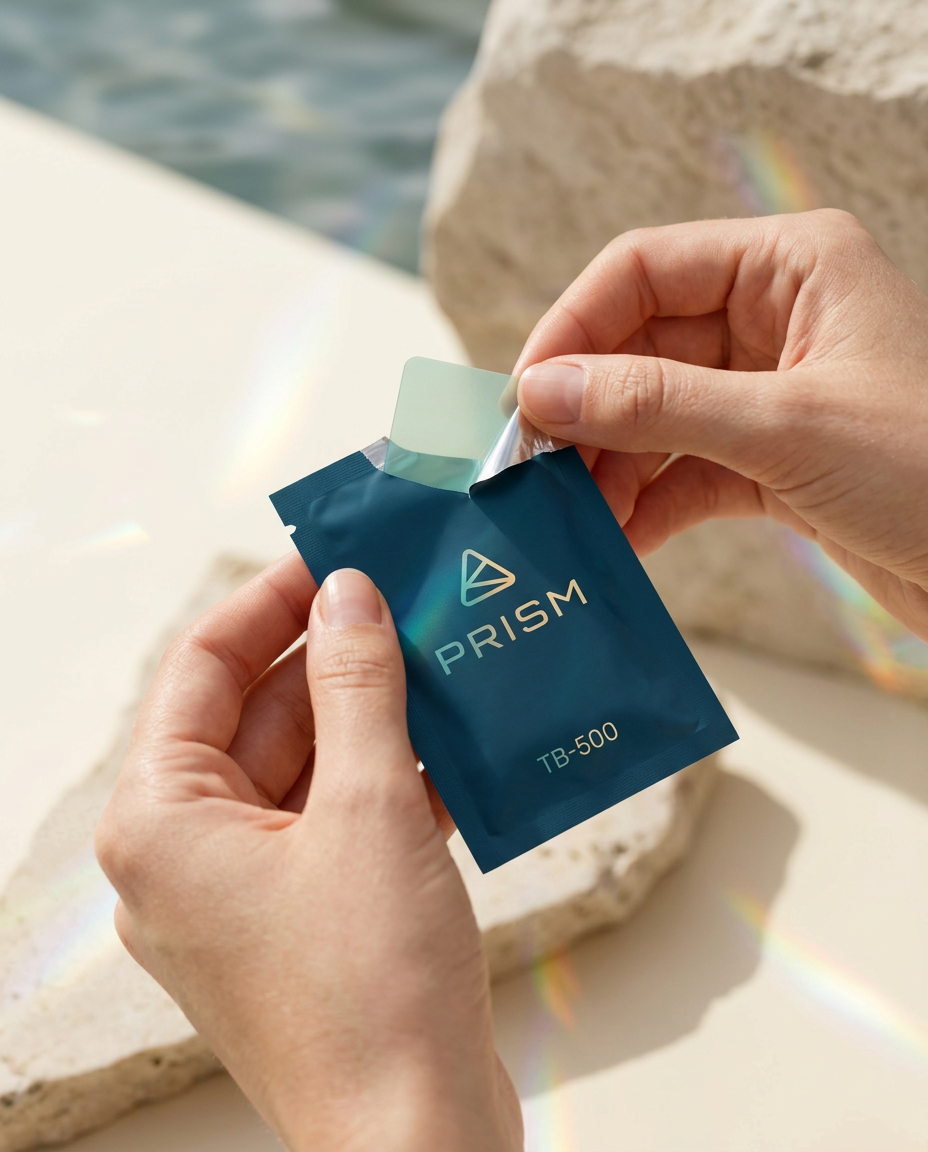
A properly engineered oral thin film can do something very different from a tablet that simply melts. Prism's film architecture is designed around several functions operating at the same time.
First, mucoadhesion. Absorption requires contact time. Instead of allowing the dosage form to float through the mouth, the film is designed to remain attached to a defined mucosal surface long enough to create an absorption window.
Second, directionality. An occlusive backing layer can reduce drug loss into the saliva and bias movement of the active ingredient toward the mucosa rather than equally in every direction.
Third, protection. Peptides are chemically and enzymatically vulnerable. Carrier systems and local formulation conditions can help protect the payload during the period when it is trying to cross the tissue.
Fourth, permeation engineering. Large, hydrophilic or charged molecules do not readily cross lipid-rich biological barriers. Prism's platform uses molecule-specific formulation strategies intended to improve the probability of transport across or between epithelial cells.
The architecture shown in Prism's scientific overview combines an occlusive backing, mucoadhesive drug reservoir and engineered carrier system specifically to create directional peptide flux toward the underlying vascular tissue.
That is very different from putting a peptide into a breath strip.
One strip does not fit every molecule
Sublingual delivery is not automatically the best answer for every drug.
A small, lipophilic molecule behaves differently from a large hydrophilic peptide. A molecule susceptible to hydrolysis requires different formulation protection than one limited primarily by permeability. A drug requiring prolonged exposure may be better suited to buccal placement than rapid sublingual delivery. And some molecules may be better served by an entirely different route.
That is why Prism is being built as a delivery platform rather than a single dosage form.
The objective is to evaluate the physicochemical characteristics of a molecule — size, charge, lipophilicity, stability and permeability — and match it to the architecture capable of solving its dominant constraint.
For some compounds, that may be an ODT. For others, a directional oral thin film. For still others, intestinal or lymphatic delivery may be more appropriate.
The science determines the format. Not the marketing department.
Better delivery changes more than convenience
Removing an injection seems, at first glance, like a user-experience improvement. It can be much more important than that.
A medicine that does not require a needle may be easier for a patient to start. Easier to travel with. Easier to administer consistently. Potentially easier to distribute through telehealth and direct-to-patient models. And, when room-temperature stability is demonstrated for the specific formulation, significantly easier to ship and store.
Those differences have commercial consequences — but they begin with pharmaceutical science.
There is also a precision advantage. Instead of asking a patient to reconstitute a vial, calculate a concentration, draw liquid into a syringe and administer the correct number of units, a finished dosage form can carry a predetermined amount of active ingredient.
The experience gets simpler because the formulation became more sophisticated.
The important data still have to be generated
None of this means an oral thin film should be assumed to perform like an injection simply because the mechanism makes sense.
Actual bioavailability is molecule-specific. Actual pharmacokinetics must be measured. Actual stability must be established. Actual human exposure has to be demonstrated.
Prism's development program is therefore designed to progress from formulation engineering into ex-vivo human-tissue permeation studies and ultimately human pharmacokinetic work measuring what reaches the bloodstream and how quickly.
That evidence matters. Because the ambition is not to create a nicer way to take a peptide. It is to build a new way to deliver one.
There is an enormous difference. The needle solved an absorption problem. We think formulation science can solve it better.